
I just finished reading Founding Mothers: The Women Who Raised Our Nation, by Cokie Roberts — a book I picked up in my lightest library book sale haul ever.
The timing was perfect! I’d just realized quite by surprise that I did not doodle my way through a book about John Adams and he’s next up my upcoming Virtual Presidential Series. Thankfully, both he and Abigail Adams appear many times throughout this book.
Do yourself a favor — go out and get a copy. These women and stories are incredible. They were a vital part of the resistance, the war effort, and of patching it all together after. They were instrumental with the boycott, raised funds, thwarted the British, burned their own wheat to ensure it didn’t feed the enemy, raised awareness, ignored cannon fire to keep soldiers fed, and more. Unlike their male counterparts, they did it all while pregnant, breastfeeding, raising babies, running the family businesses, not having any rights, and with little-to-no acknowledgement, etc., etc.
Flip through my sketchbook.
Then scroll through more doodles. As always, my doodles don’t highlight the most important parts of the book. And they are in no particular order. Certainly not chronological.
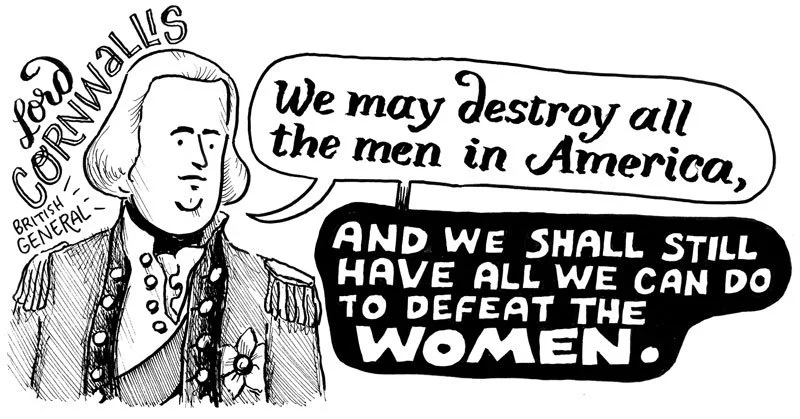
Cornwallis
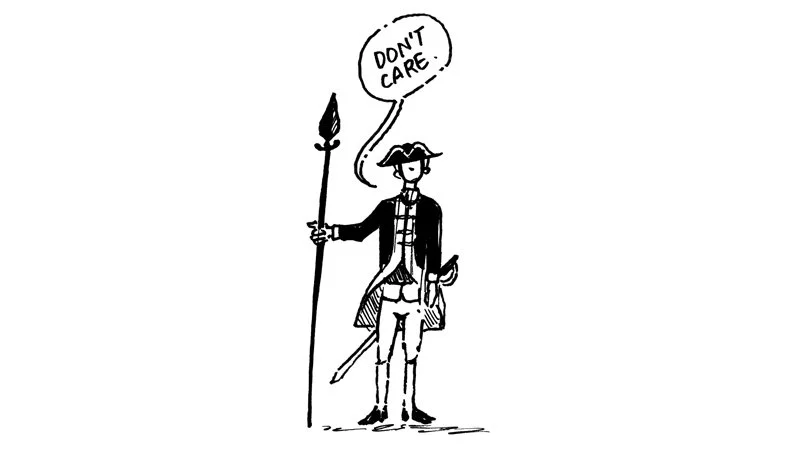
British General Lord Cornwallis whined “We may destroy all the men in America, and we shall still have all we can do to defeat the women.”
After defeating Cornwallis, Washington named a dog after him.
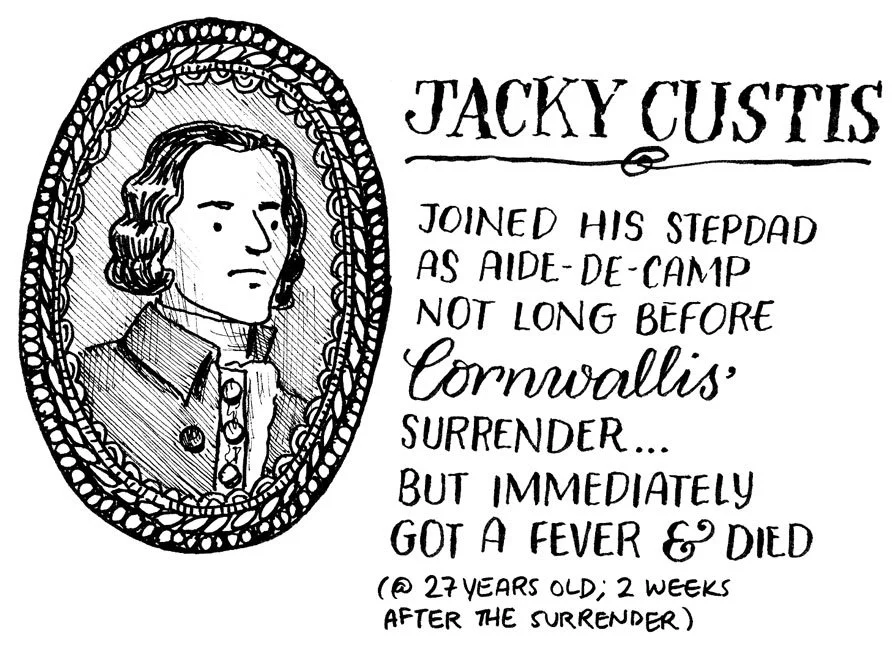
Speaking of Cornwallis … Martha Washington’s son, Jacky Custis, had stayed out of the war but eventually joined his step dad as aide-de-camp not long before Cornwallis’ surrender. 27-year-old Custis immediately got a fever and tragically died two weeks after the surrender.
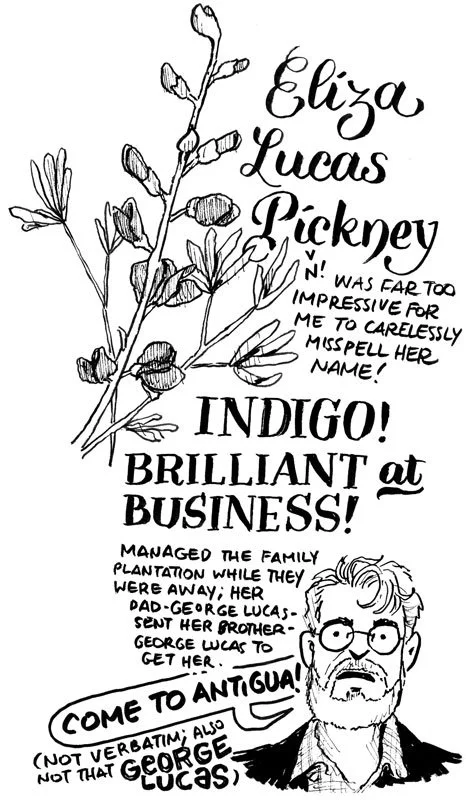
Eliza and indigo
I’d never given any thought to indigo farmers/farms/plantations, but read about Eliza Lucas Pinckney here … and then not too long after … it was briefly mentioned in this podcast.
“The revolutionary army basically took the design for the famous British redcoats and turned them blue, in part, apparently, because of how much indigo was produced on American plantations.” — I nearly lost it when I heard this clip. That’s Eliza!!
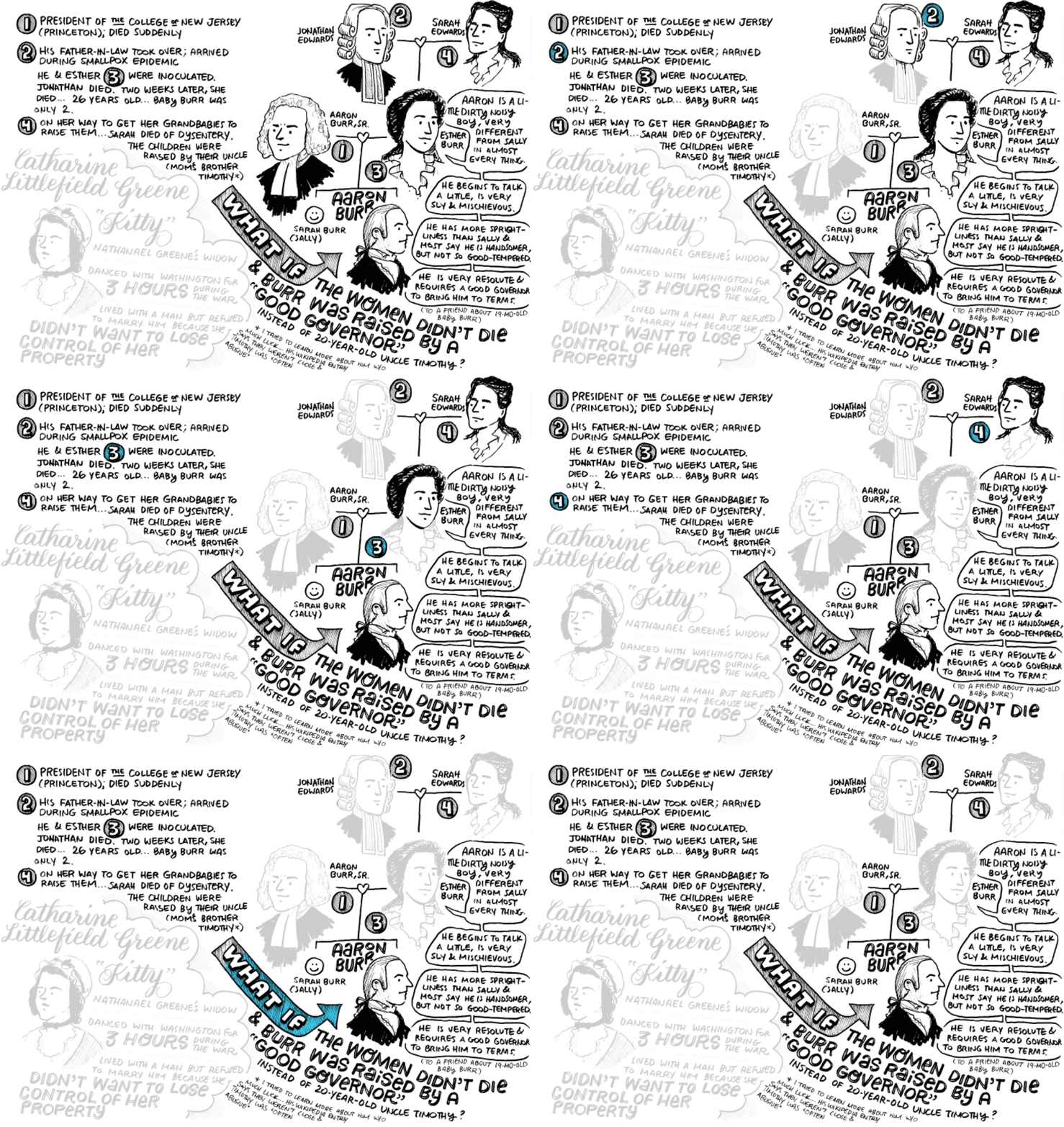
What if the women in Aaron Burr’s family didn’t die?
In rapid succession, little bitty baby Burr ⚔️lost:
his father
his grandfather
his mom
his grandmother
20-year-old Uncle Timothy (perhaps ill-prepared; perhaps abusive) was not the “good governor” his mom knew the young, sly, mischievous boy needed to keep him in line. Perhaps Hamilton ⚔️wouldn’t exist if he’d had such a governor.
Benjamin Franklin … not a great husband
Here’s a little poem published about him when he was running for Pennsylvania state assembly:
Franklin, though plagued with fumbling age
Needs nothing to excite him,
But is ready to engage,
When younger arms invite him.
He cautioned his wife that women shouldn’t meddle in politics “except in endeavors to reconcile their husbands, brothers and friends who happen to be on contrary sides….”
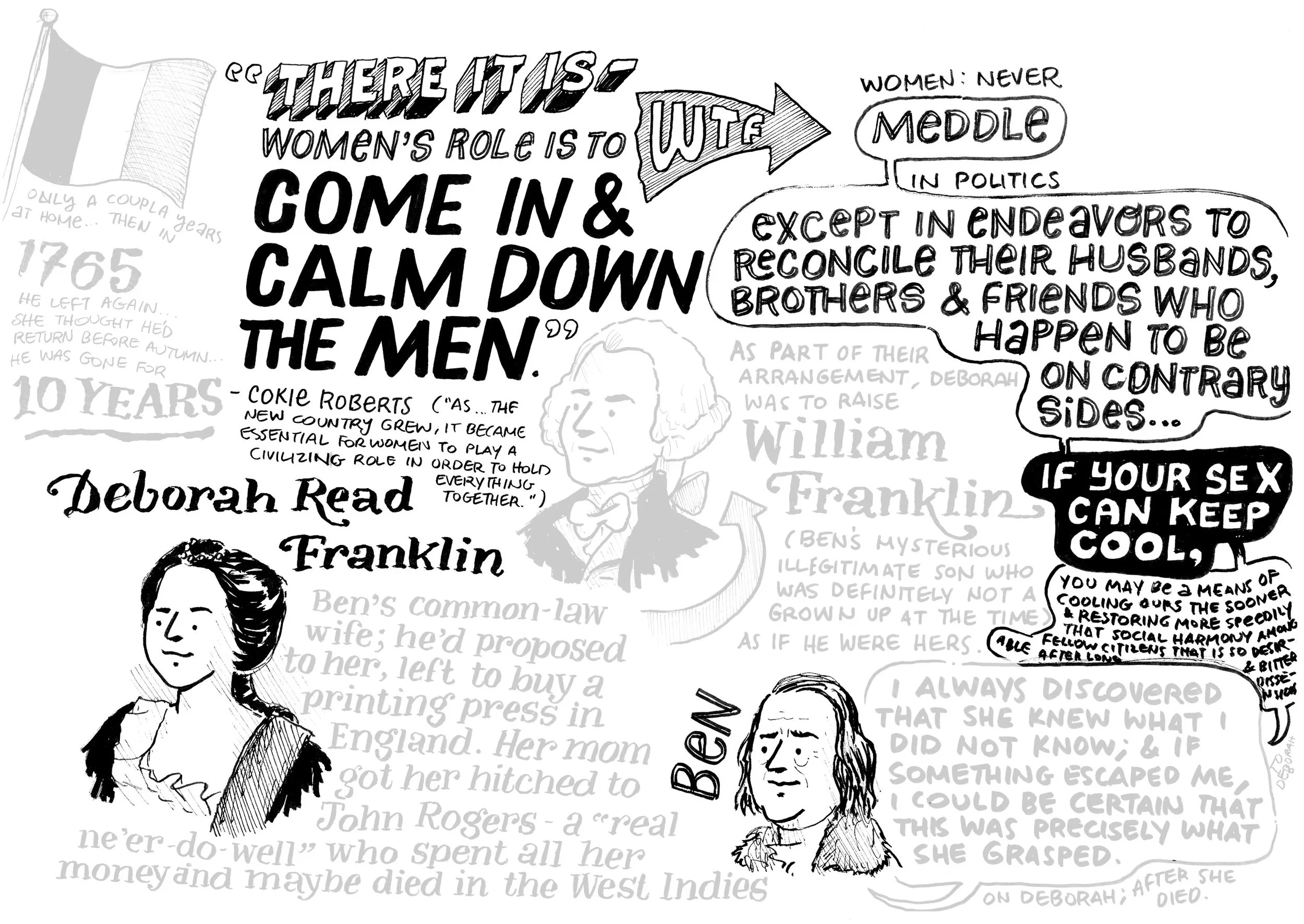
Side note that seems relevant: an alarming number of men in this book participated (or even died or killed) in a duel. See if you can find the sampling I included in this post! ⚔️ Definitely seems like their sex can’t keep cool. That can’t be right though…? Would you like to guess how many women in the book died whilst dueling?
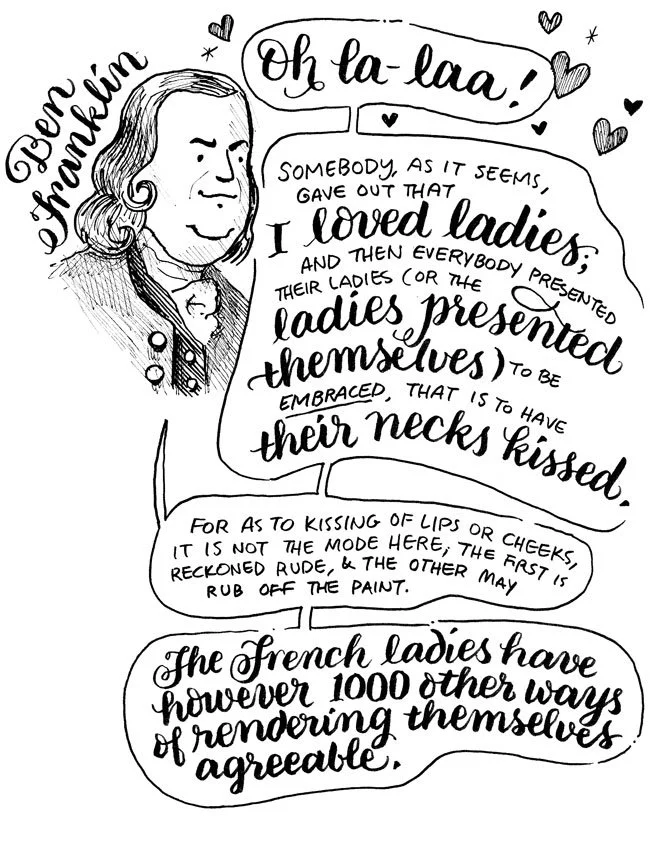
Ben Franklin loved him some ladies and, heaven help them, those ladies loved the gouty Ben Franklin right back.
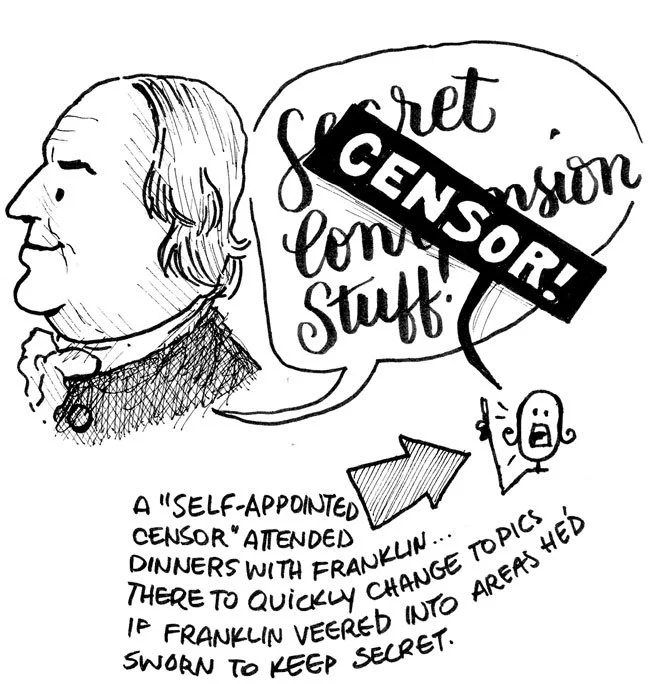
Later in life, a “self-appointed censor” attended dinners with Franklin to quickly change topics if when Franklin veered into Secret Convention Stuff that he’d sworn not to talk about.
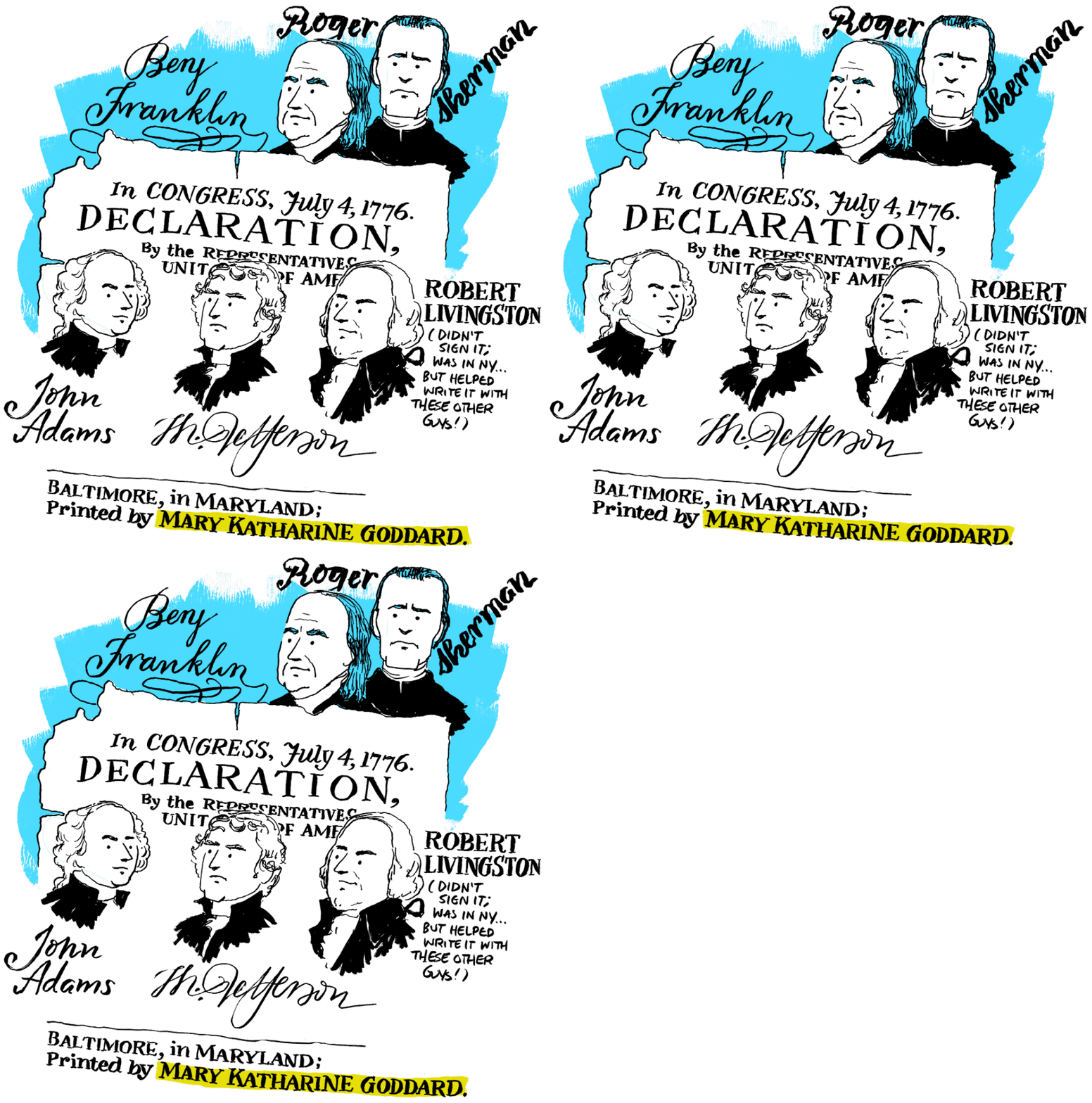
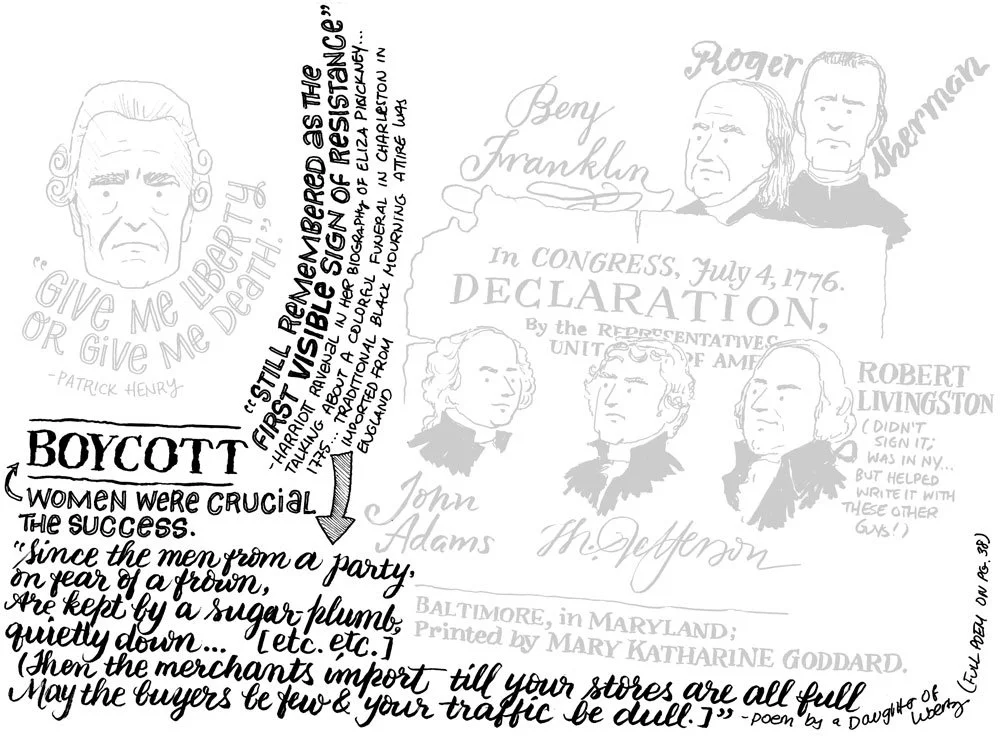
A woman’s name is on the Declaration of Independence and why do we not talk about that?
Mary Katharine Goddard, a Baltimore-based newspaper publisher, would have hung along with the men if caught. (She showed up in a recent Remedial Herstory Project podcast!)
Kept by a sugar-plumb
Women were crucial to the success of the boycott. In her biography of Eliza Pinckney, Harriott Ravenal describes colorful funerals — a result of not being able to import traditional black mourning attire from England — “still remembered [at the time] as the first visible sign of the resistance.”
But this poem by a Daughter of Liberty… I imagine she dropped the mic when she was done reciting it:
Since men from a party, on fear of a frown,
Are kept by a sugar-plumb, quietly down.
Supinely asleep, & deprived of their sight
Are stripped of their freedom, and robbed of their right.
If the Sons (so degenerate) the blessing despise,
Let the Daughters of Liberty nobly arise,
And though we’ve no voice but a negative here.
The use of the taxables, let us forebear,
(Then the merchants import till your stores are all full
May the buyers be few and your traffic be dull.)
One more time… just that first bit…
Since men from a party, on fear of a frown,
Are kept by a sugar-plumb, quietly down.
I mean… come on!
NOTE: it’s spelled “plumb” in the book. This isn’t a typo on my part. This time.
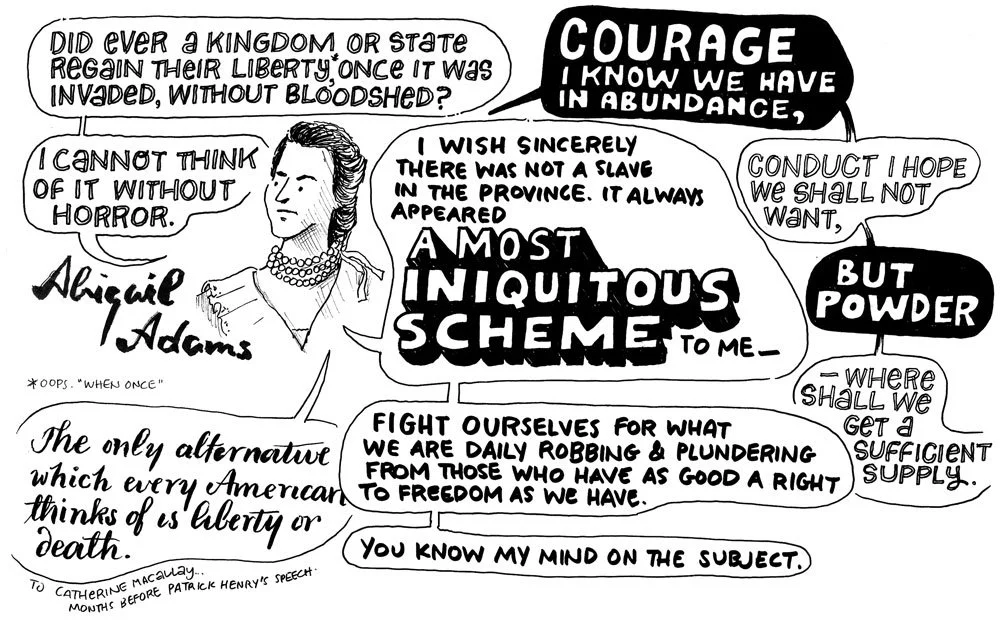
I ♥ Abigail
John Adams leaned on her and sought her advice even more than I realized. Her are some of her gems:
“Did ever a kingdom or state regain their liberty when once it was invaded, without bloodshed? I cannot think of it without horror.”
“The only alternative which every American thinks of is liberty or death.” (This was months before Patrick Henry’s speech.)
“Courage I know we have in abundance, conduct I hope we shall not want, but powder — where shall we get a sufficient supply.”
“I wish sincerely there was not a slave in the province. It always appeared a most iniquitous scheme to me — fight ourselves for what we are daily robbing and plundering from those who have as good a right to freedom as we have. You know my mind on the subject.”
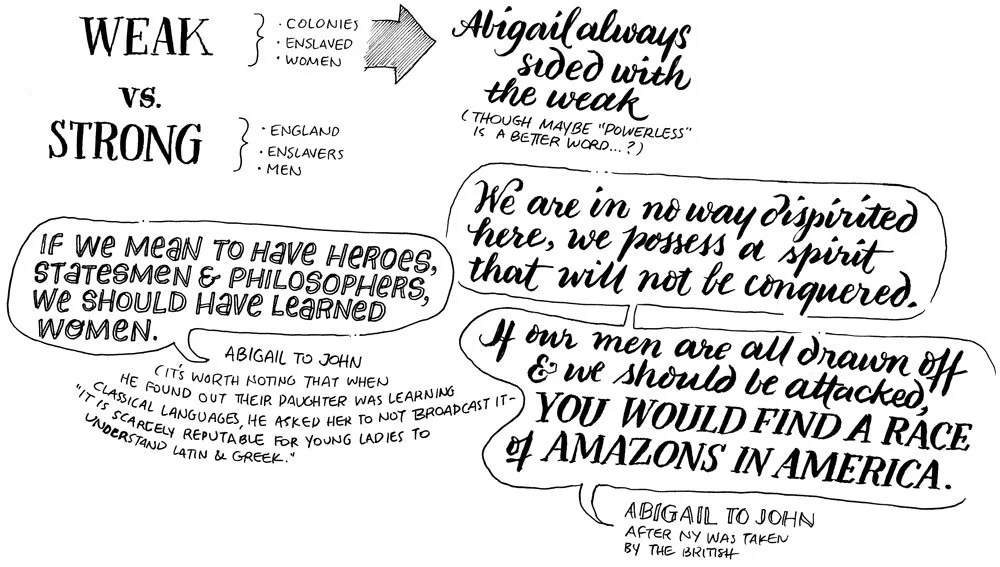
Abigail always sided with the weak powerless: colonies, the enslaved, and women over England, enslavers, and men.
She valued education for women: “If we mean to have heroes, statesmen and philosophers, we should have learned women.” (I should point out that while John Adams was fine with their daughter learning classical languages … as long as nobody really knew that was happening because “it is scarcely reputable for young ladies to understand Latin and Greek.”
After New York was taken by the British, she wrote to her husband “We are in no way dispirited here, we possess a spirit that will not be conquered. If our men are all drawn off and we should be attacked, you will find a race of Amazons in America.”
Civil War, fleeing Fluckers, and the Howe Brothers
The Revolutionary War wasn’t just Americans vs. British. It was Americans vs. Americans — a civil war. That blew my mind.
Before Henry Knox was dragging artillery through the mountains, he was marrying Lucy Flucker … much to her Loyalist family’s dismay. With his sword sewn into Lucy’s coat, they busted outta Boston … he did the whole Fort Ticonderoga thing (Knox’s idea!!) and then those Fluckers fled … along with the British and thousands of other Loyalists.
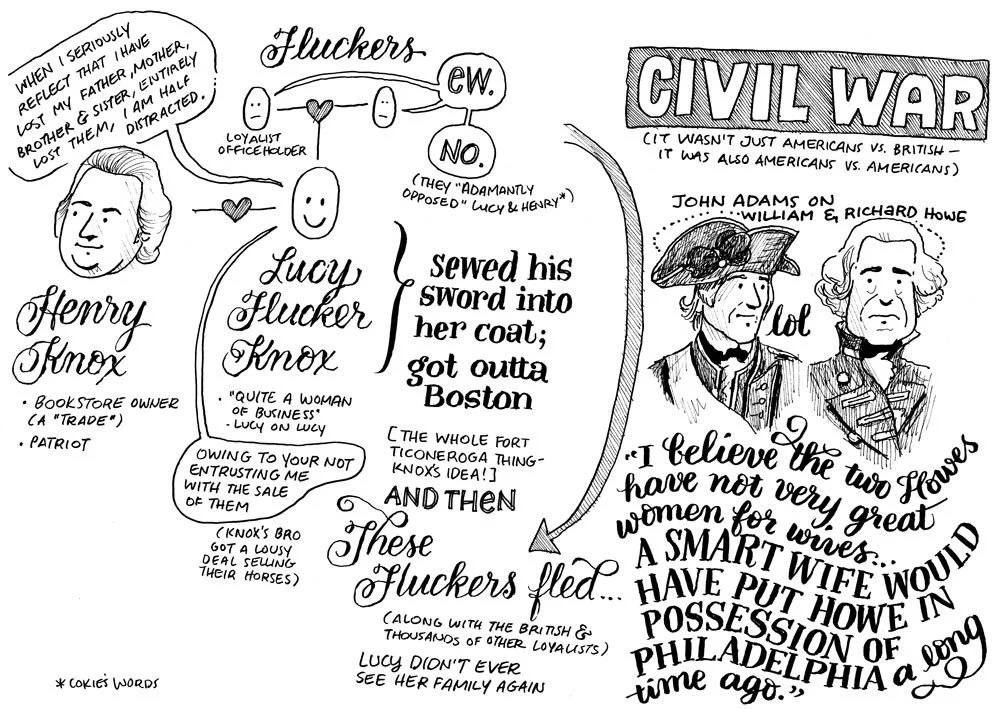
Oh, the Howe brothers! Good ol’ William and Black Dick. [giggles] On them, John Adams wrote “I believe the two Howes have not very great women for wives… a smart wife would have put Howe in possession of Philadelphia a long time ago.”
William Howe was apparently busy having a not-so-secret affair with a woman who was trying to score favors for her husband in the British army. Here’s one of the poems written about him:
Awake, awake, Sir Billy,
There’s forage in the plain.
Ah, leave your little filly,
And open the campaign.
Schuyler, Burgoyne, Reed, and the Stocktons
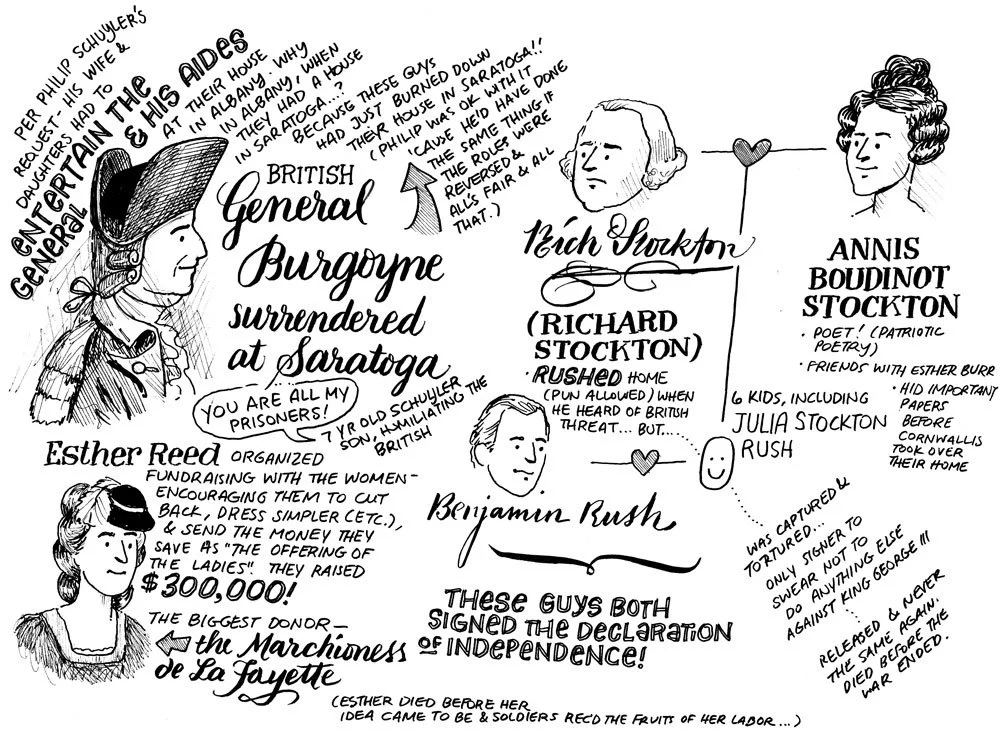
Catherine Schuyler’s husband had her and his daughters entertain British General Burgoyne and his aides at their house in Albany after he surrendered at Saratoga. Why not entertain at their house in Saratoga, since Burgoyne was there already? Oh, because Burgoyne burned it down. Philip was ok with it, ‘cause he’d have done the same thing if the roles were reversed and all’s fair and all that.
BTW: their 7-year-old humiliated the British by announcing “You are all my prisoners!” and then closing the door on them.
Esther Reed organized a massive fundraising effort with women — by cutting back on expenses, they raised $300,000! She died before she could see the fruits of her labor.
Poet Annis Boudinot Stockton’s husband and son-in-law both signed the Declaration of Independence. Richard Stockton rushed home when he heard of a British threat. Annis hid important papers before Cornwallis took over their home, but they captured Richard. He was tortured and the only signer to swear not to do anything else against King George III. He was never the same again after his release and died before the war ended.
Behold! A beautiful map and timeline showing their whereabouts and whenabouts overseas!
That’s what I hoped to share.
In reality, IDFK what is happening here. Cokie Roberts (no disrespect) rolled out the info in non-chronological order, almost as if she didn’t anticipate that I’d need the information carefully and logically spoon-fed to me so I could make a fun little motion graphic. She’d say things about Thomas Jefferson being appointed blah-blah-blah to France. So I’d dutifully draw him, only to find out pages later that he declined the appointment to stay by his ailing wife’s bedside. It’s not her fault. Apparently, this is not information that is easy to piece together.
In any case. Here’s a map. It has people. It has places. Sometimes the people were in the places. Sometimes they weren’t. Frequently I have to assume they were in a place but I do not know where the place is. It’s not the best. [shrugs]
You may notice I kinda gave up at the end.

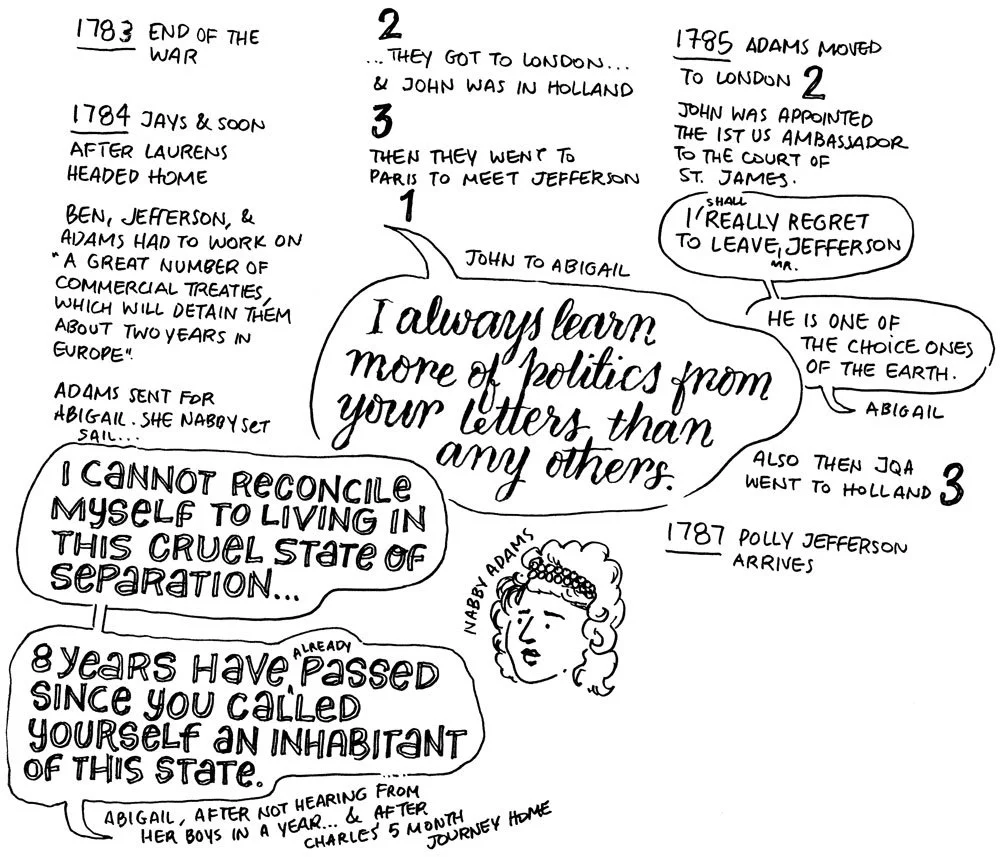
Please note that Abigail told John “if I realized before you left me that the intercourse between us would have been so hazardous, I feel my magnanimity would have failed me.”
The Livingstons
There were two batches of Livingstons discussed in this book:
The New York batch
The New Jersey batch
In the New York batch, we have Margaret Beekman Livingston. Her estate, Clermont, was burned to the ground. She refused to leave, moving into a cottage. The British left her alone.
Her daughter, I thought, wasn’t so lucky. Upon drawing this doodle (and getting lost in Livingston family trees), I realized it was her daughter’s mother-in-law who wasn’t so lucky. Gertrude Livingston Lewis was married to Morgan Lewis. His dad was a “marked man” having signed the Declaration of Independence. When the British realized his wife Elizabeth Lewis was home without protection, they attacked. They freaking fired a man-of-war at her house before dragging her off to prison!
She was held captive and treated poorly for months until George Washington arranged a prisoner exchange. She was never the same and died two years later. A descendant said “Mrs. Lewis could not have been more a victim to the Revolution had she been slain in battle.”
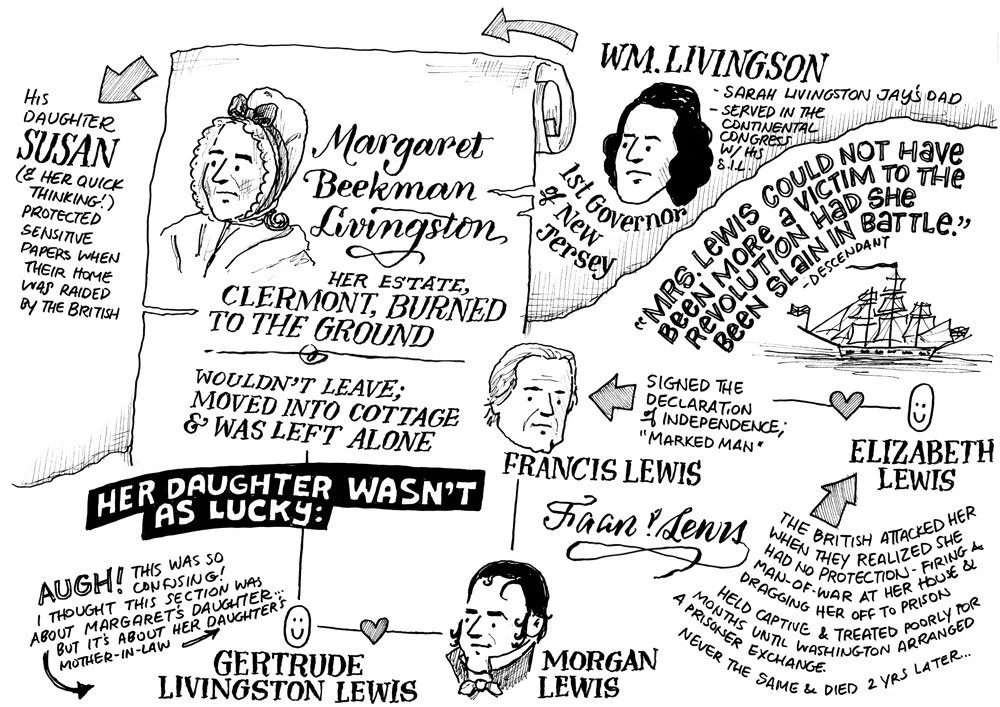
It looks like I misspelled “Livingston” in the upper right corner of the doodle above. Would you believe that there was a boycott on T…?
In the New Jersey batch, we have William Livingston. He became the first governor of New Jersey. He served in the Continental Congress with his son-in-law, John Jay, who was married to his daughter Sarah Livingston Jay.
His daughter Susan (and her quick thinking!) protected sensitive papers when their home was raided by the British.
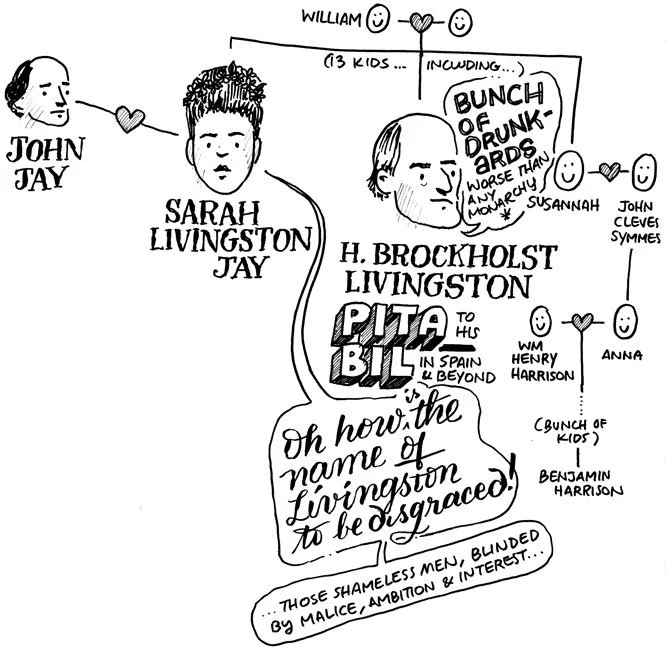
Brockholst was a PITA
Sarah Livingston Jay’s brother (who was 12 year’s younger than her husband, John Jay … don’t let the doodle fool you!) was a giant pain in the ass to his brother-in-law. Not only had he betrayed Jay in Spain, publicly referring to the men who appointed Jay as something akin to a bunch of drunkards who were worse than a monarchy (in a slight rephrasing of Cokie Roberts’ words), but he and other relatives also worked against Jay when he ran for New York Governor against George Clinton. An exasperated Sarah Livingston Jay wrote “Oh how is the name of Livingston to be disgraced… those shameless men, blinded by malice, ambition and interest…”
I was also delighted to know that Susannah, another sibling, was the stepmom of a future First Lady so I had to add that as well.
Speaking of George Clinton
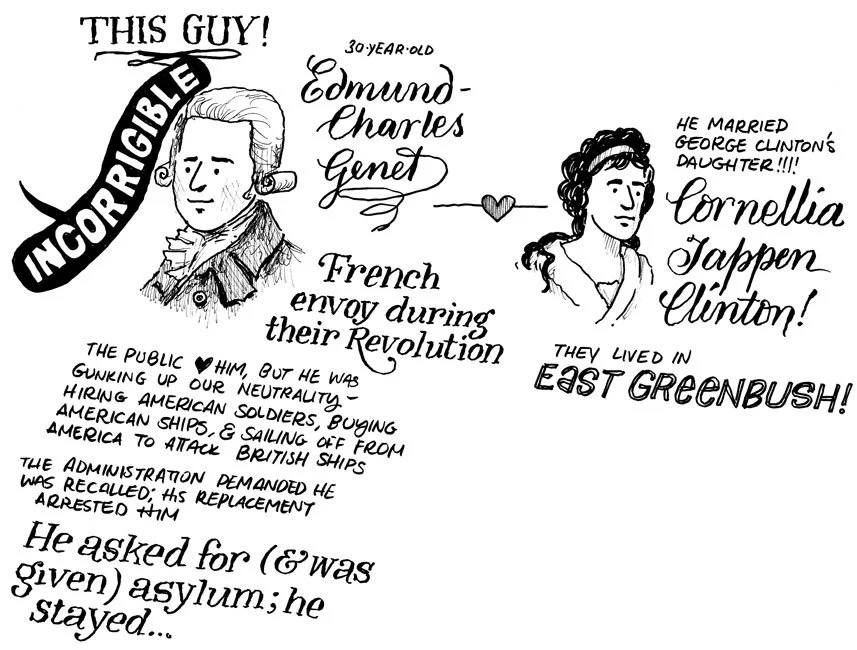
I first read about the incorrigible Edmond-Charles Genet in Lindsay Chervinsky’s The Cabinet. (See the doodles here, if you want.)
Naturally, I was excited when he showed up because this guy — he was something. The public loved him, but he was gunking up our neutrality. He went behind us, hiring American soldiers, buying American ships, and sailing off from America to attack British ships. Tooootally putting our whole experiment at risk. The administration demanded that he was recalled. His replacement came to arrest him and then (get this!!) he asked for asylum!! (Because, you know, guillotines and all that.)
Despite us asking him repeatedly to stop his shenanigans and him not listening, we granted asylum.
He ended up marrying Cornellia, the daughter of future New York Governor George Clinton! They lived in East Greenbush! He’s buried there, too! These are things I did not know! And, as you can probably tell from this string of sentences ending in exclamation points, I am very excited about all of this new information!
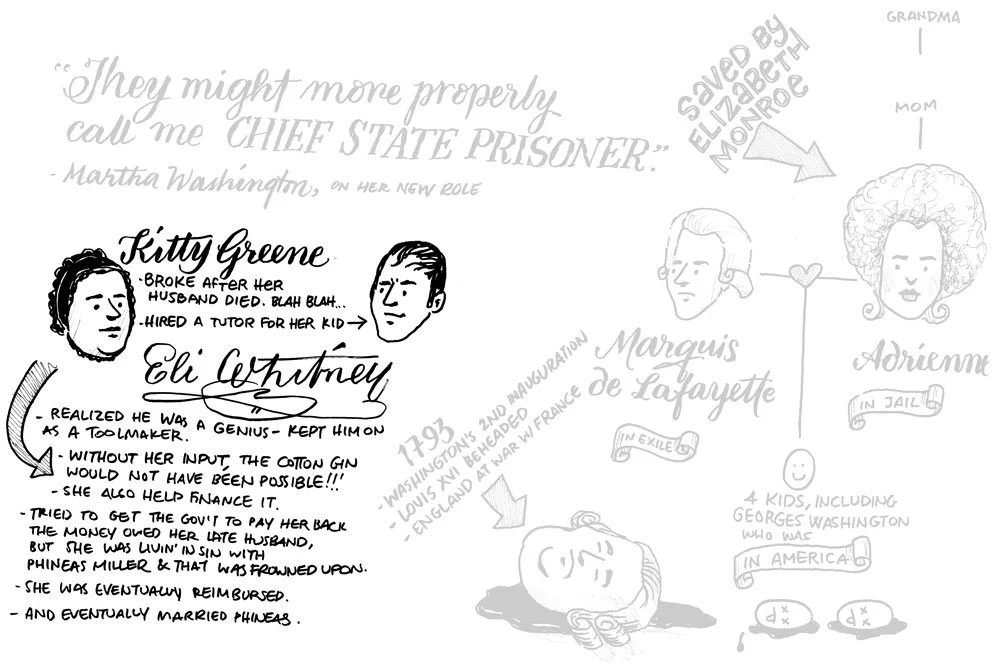
Without Kitty Greene, there’s no cotton gin
I remember learning about the cotton gin in elementary school and how it was A Big Freaking Deal. I do not remember learning that it wouldn’t have happened without Kitty Freaking Greene.
Kitty (widow of Revolutionary War hero Nathanael Greene) hired Eli Whitney as a tutor for her kids, but then realized he was a genius. Kept him on as a toolmaker. He was working on the cotton gin but struggling a bit. She came up with the solution. And also helped finance it.
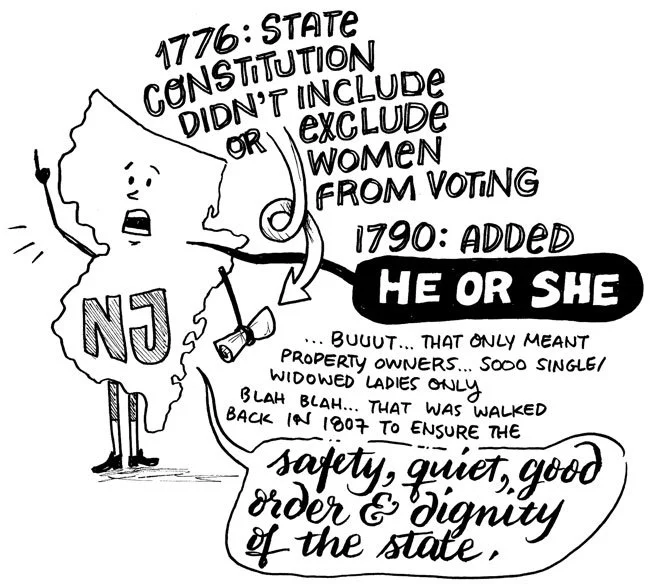
Quiet, safety, dignity and all that
New Jersey’s original state constitution didn’t include or exclude women from voting. In 1790, they added “he or she” which is cool buuuuuut it only meant property owners soooooo single/widowed ladies only. Blah blah blah, they walked it back in 1807 to ensure the “safety, quiet, good order and dignity of the state.”
I read previously that it was because women weren’t cooperative with their voting. So safety, quiet, good order, dignity, and the guy we want in the White House. Awesome.
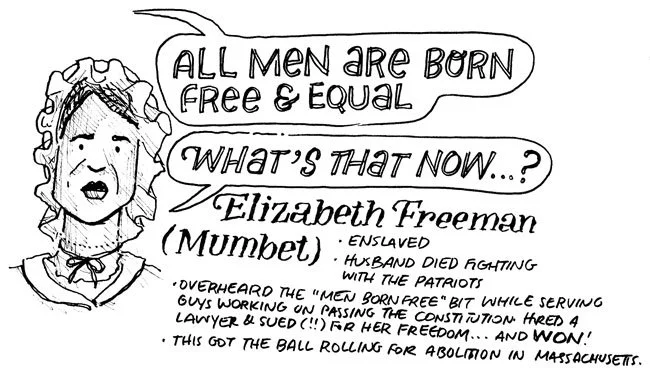
All born free and equal, you say…?
Elizabeth Freeman (also known as Mumbet) was widowed when her husband died fighting with the Patriots. She was enslaved at a home that frequently entertained Very Important People and she overheard the guys working to pass the Constitution say “all men are born free and equal.” She went ahead and hired a lawyer and sued for her freedom — and won! Her case got the ball rolling for Abolition in Massachusetts.
Daddy Vice
Ew. No thank you.
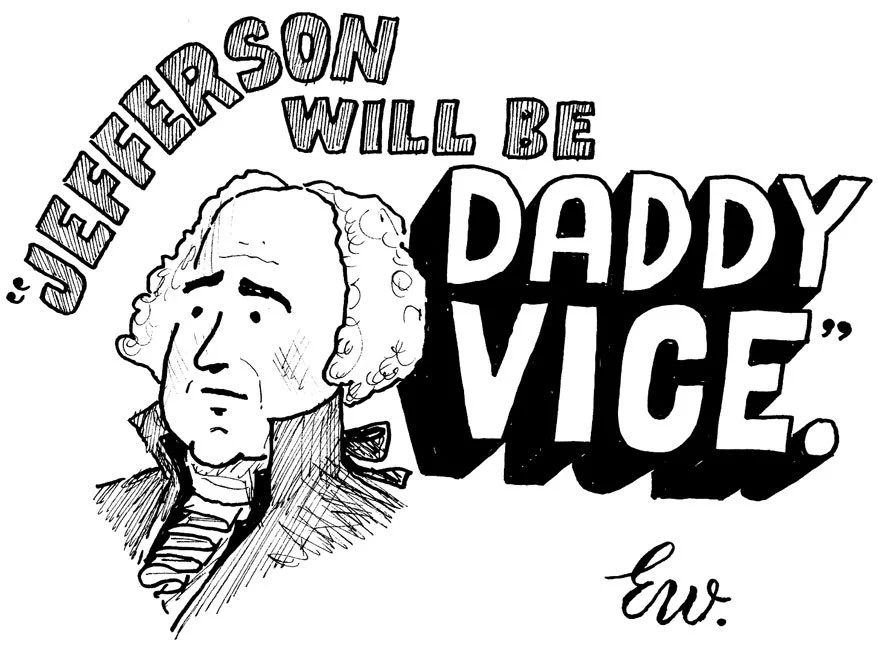
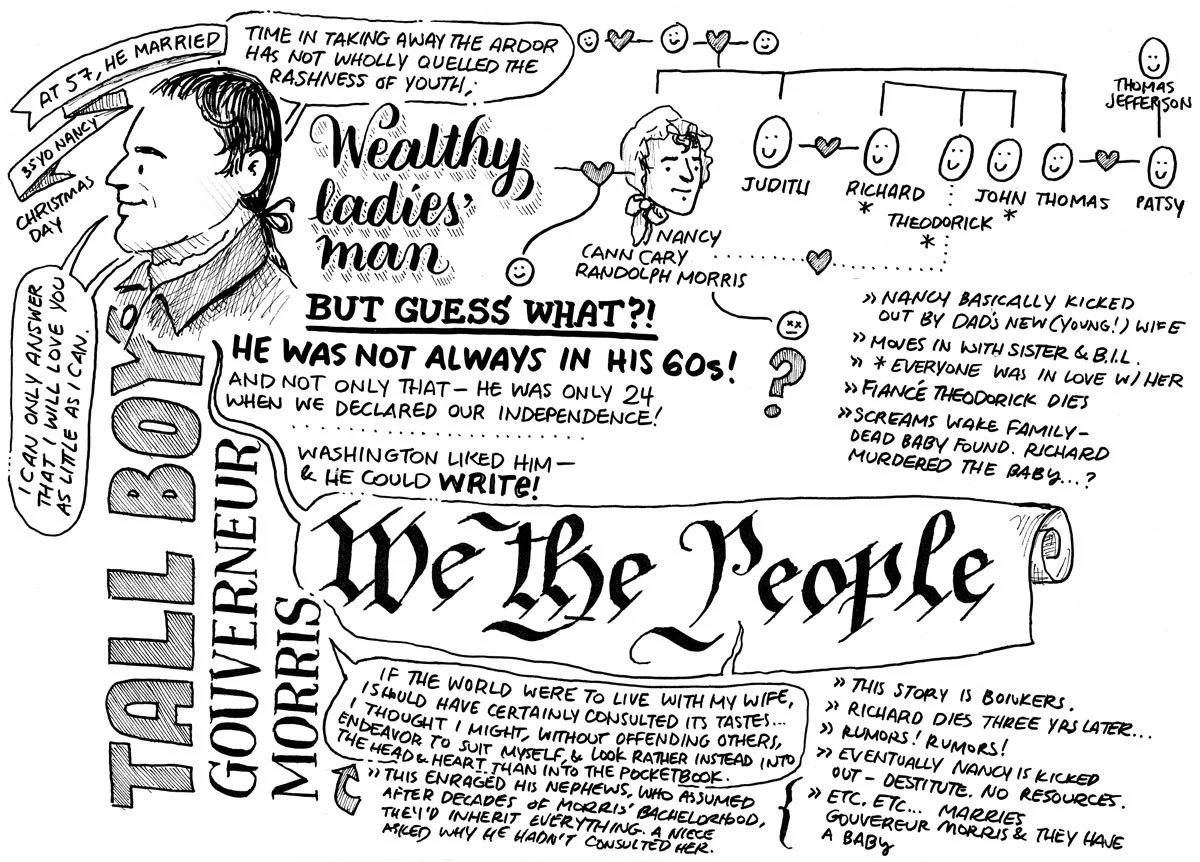
Um, this story is so loaded, I had to devote an entire post to it.
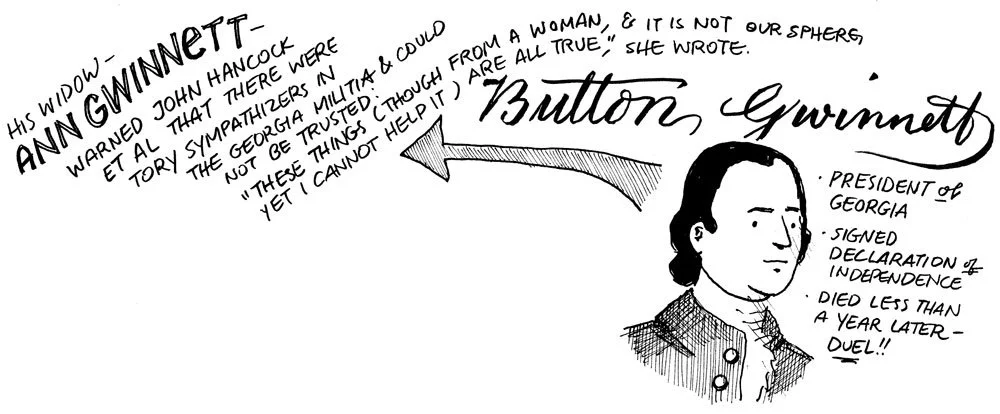
Ann & Button
Button Gwinnnett ⚔️was president of Georgia, signed the Declaration of Independence, then died less than a year later due to injuries from a duel. The duel was over who would control the Georgia troops securing the border with Florida.
Ann Gwinnett, his widow, warned John Hancock etc. that there were Tory sympathizers in the Georgia militia who could not be trusted. She couched her intel with “These things (though from a woman, and it is not our sphere yet I cannot help it) are all true.”
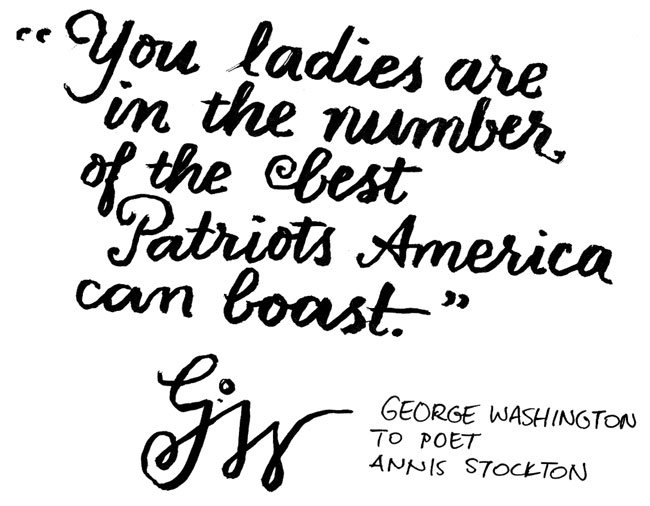
The best patriots America can boast
George Washington wrote to Annis Stockton “Nor would I rob the fairer sex of their share in the glory of a revolution so honorable to human nature, for indeed, I think you ladies are in the number of the best patriots America can boast.”
More posts like this:








Mrs. Ex President T